
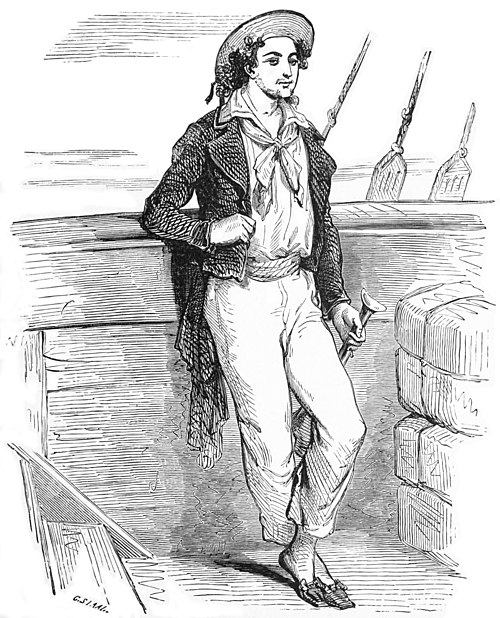
Mrs. Stephens has recently introduced me to ‘television’! While modesty can only cause me to recoil from the shocking depictions of brazen women and brutish men (I may never again be able to read the word ‘bone’), I could not resist viewing a presentation of The Count of Monte-Cristo on something called Masterpiece Theatre. Please note that, unlike Masterpiece Theatre, *I* use the original spelling.
Alexandre Dumas’ tale of the wronged and vengeful Edmond Dantes has been one of the most popular books in European literature. French readers went mad for it during its first publication as a serial from August 1844 to January 1846 in the Journal des Débats. As there were numerous booksellers in other countries, including Great Britain, that sold French literary and periodicals, word of the story spread like a veritable conflagration.
Mind you, a number of critics and other novelists poo-pooed Dumas’ success. In France, Gustave Flaubert dismissed The Count of Monte-Cristo as a novel about superficial characters that “resolves itself without a single minute for reflection.” In the British Quarterly Review, George Henry Lewes dismissed the work as “a waste of time” and referred to his readers as persons “who read simply for amusement . . . to fill the vacant hours of their useless lives.”
To Mr. Lewes, I say, “Harumph!”
One English periodical, The Leader, insisted on March 30, 1850 that Dumas was “laughed at by all Europe, despised by all Europe, but read by all Europe.”
In modern parlance, Monsieur Dumas cried all the way to the bank.
In Britain, Ainsworth’s Magazine serialized an abridged English translation of the Count of Monte-Cristo in 1846. I devoured every issue and counted the days until the next one. The novel was discussed over every tea-table: What Dantes would do next, the villany of Villefort, the trials of the young lovers Maximilien and Valentine. Absolutely everyone knew the story!
When the first unabridged English translation was published in book form in 1846, you may be sure I spent my pin money on both volumes, and read all 117 chapters. (Really, I do not understand how modern minds boggle at the idea of reading a mere 400 pages.)
One last note in the interests of honesty. It was later revealed that Alexandre Dumas père depended on what are now called ghost writers for his prodigious output. He wrote The Count of Monte-Cristo and The Three Musketeers (among other works) with Auguste Maquet, a historian who had turned to writing fiction. Eventually, Maquet would sue Dumas for rights to co-authorship and royalties for . The courts decided in favor of Dumas, and after 1851 Maquet ended their association. He then successfully wrote his own plays and novels for several years until he died in comfortable circumstances, respected in his own right by his contemporaries.
But he never achieved the fame alone that he had done with Alexandre Dumas, and Dumas never achieved the readership that he did working with Maquet.
And now a word from Ann
I hope readers enjoy the posts written in the voice of my alter-ego, The Gentlewoman. I truly enjoy writing them. For one thing, I read a lot of Victorian era books (including the full, unabridged 117 chapters of the Count of Monte Cristo), along with newspaper articles, letters and diaries when I can find them online. The language used was far more formal — and often convoluted — and writing as a woman from 19th century Britain helps get that style out so that I can write for modern audiences.
A few things that I couldn’t work into the Gentlewoman’s post might be of interest to you. First, writers for periodicals and newspapers, including journalists, were paid one of two ways: either by the column inch, or by the word. The latter lasted into the 20th century. In On Writing, Stephen King writes of getting paid by the word when he was starting out. helps to get those conventions out of my brain.
Second, Dumas père had a family history worthy of his swashbuckling books. His father was a native of the island of Haiti, born the bi-racial son of a French marquis and an African slave. Thomas-Alexandre Dumas Davy de la Pailleterie was taken to France after his father sold his mother and two siblings. Thomas-Alexandre never saw them again. He was placed in military school, given a nobleman’s education, and joined the military in 1786. When the French revolution broke out, he took the side of the République, and by September of 1793 he was a commander-in-chief of the revolutionary Army of the Western Pyrenees. Unfortunately, Thomas-Alexandre eventually fell afoul of Napoleon Bonaparte and was forced out of his military career.
Dumas was Thomas-Alexandre’s only legitimate son, and it is speculated that Alexandre’s proclivity for writing high adventure was influenced by the career of his father.
Alexandre’s son, another Alexandre (known as Dumas fils), was born of an affair with a dressmaker named Marie-Laure-Catherine Labay. Born in 1824, the younger Alexandre was acknowledged by his father when he was around 5 years old. While this gave the boy some standing socially and legally, French law gave all custody rights to a child’s father. (This was the norm throughout Europe and in the United States, and a major plot point in a manuscript I recently finished.)
Thus mother and child were torn apart, and it is believed that her agony affected much of Dumas fils’ writing. He had his own agony, as his school days were marked by insults both for his African heritage and his bastardy. As an adult, his novels and plays often reflected the belief that men who fathered illegitimate children should legitimize them and marry their mothers. Dumas fils wrote his best-known work, La Dame aux Camélias, in 1848. It is known in English as Camille. To make some money quickly, Dumas the younger wrote the novel up as a play, which proved to be an even bigger hit than the book. The composer Guiseppe Verdi even used it as the source for his opera La Traviata. Following his theatrical triumph, Dumas fils turned largely to writing drama. During his lifetime, his fame surpassed his father’s.
A Few Book Recommendations
- The Black Count, Tom Reiss – a biography of Thomas-Alexandre
- The Count of Monte Cristo, Alexandre Dumas – if you’re feeling brave
- The Three Musketeers, Alexandre Dumas – also long, courage needed
- Or you can watch the Count on Masterpiece Theatre and the 1972 version of Musketeers.
Does anyone else have some 19th century book recs? Or movie/TV recs based on 19th century fiction? I’d love to compare notes!
A Few Tidbits
I now (finally) have buy links on my Bookshelf page, if anyone is interested in my ebooks. Except for Amazon which is giving me difficulties at the moment – I hope to have this resolved soon.
My books are available on the Zon — it’s just that right now that you will have to navigate there instead of following a link.
Questions or comments? Let me know!
Discover more from Ann Stephens
Subscribe to get the latest posts sent to your email.

