
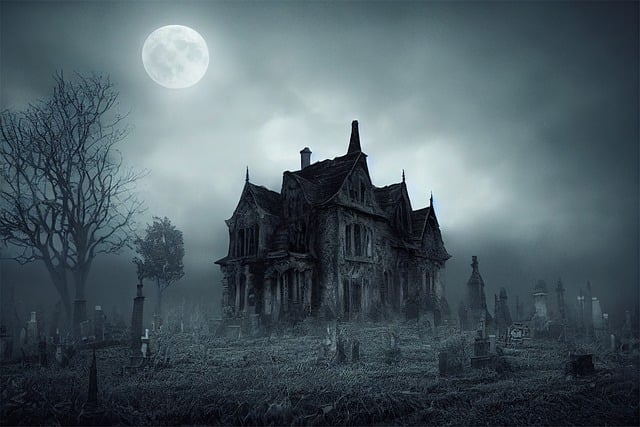
Elizabeth Gaskell: author of 19th century gems such as Cranford, Mary Barton, and North and South. Also Elizabeth Gaskell: author of Gothic short stories, filled with all the hauntings, burning hearts, family curses and general melodrama that Victorian readers craved. (Image by Sandy Flowers from Pixabay. Assisted by AI.)
I was amazed to find that this cheerful, hospitable minister’s wife, with her sympathetic observations of Manchester’s slums and the factory workers who lived in them, wrote gothic horror. Not all of her short stories belong to this genre – for example, the genteel and delightful Cranford was a compilation of short stories written mostly between 1849 and 1853, for Sartain’s Union Magazine and Charles Dickens’ periodical, Household Words. Other short stories could be considered part of her ‘industrial fiction’ along with most of her major works.
However, several of her shorter pieces include the hallmarks of Gothic horror: an oppressive atmosphere, supernatural elements (if not always ghosts), guilty secrets of a family or individual, long-lost relatives, physical or emotional isolation, and, of course, creepy old manor houses.
The truth is that Elizabeth Gaskell thoroughly enjoyed telling and writing ghost stories. She collected them, taking an avid interest in local folk tales wherever she traveled. She was known for frightening her guests with gruesome tales told with trademark gusto.
But who read them?
The majority of her short works were published in Household Words and then All the Year Round, both owned by Charles Dickens. He started them to increase his own sales and readership, but he also solicited pieces from other popular writers. Everyone benefited: magazine sales profited Dickens, the writers were paid per story, and everyone got more readers. He dismissed ghosts and eerie events, but he was happy to use them in works like Bleak House and A Christmas Carol to attract readers. As for his periodicals, hardly an issue came out without a ghost story, many of which came from Mrs. Gaskell’s pen.
Dickens aimed for a middle-class audience, so the fiction reflected the popular culture of mid-nineteenth century Britain. True, the British were starting to embrace books and plays representing realistic characters and situations, as witnessed by the success of Gaskell’s novels about the poor and working class. At the same time, the influence of the Romantic era still appealed to the reading public. Brooding heroes, family curses, revenge, unexplained insanity and forbidden/betrayed love filled books, magazines, plays and ballets. Alongside this, audiences adored sentimentality and unrealistically elevated views of human nature, domesticity, and childhood innocence. Gothic literature and stage pieces hit all these notes.
The appetite for things that went bump in the night was likely encouraged by one of the harshest facts of the 19th century: Victorians lived with death from disease in a way that many of us find hard to grasp. Before antibiotics and vaccines, diseases like measles, whooping cough, sepsis, and tetanus routinely killed people before their 18th birthday. Other fatal diseases that spread before the acceptance of germ theory were cholera, typhus and typhoid fever. Tuberculosis, known as consumption, slowly killed people of all ages.
What else might have inspired Mrs. Gaskell?
Even if you survived childhood, one estimate is that you had a 30% chance of losing at least one parent before your fifteenth birthday. Belief that cherished parents or children lived on in the after-life, and might still influence or visit, must have offered comfort. Gaskell’s own mother died when she was thirteen months old, six of her seven siblings died in childhood, her adored older brother was lost at sea, and then she in turn lost her only son when he was only a year old. As a minister’s wife, she had a firm belief in a world beyond ours. Irreligious superstition was frowned upon in so respectable a woman, but at the same time, she insisted to friends that she had once seen a ghost. (Alas, there aren’t details in the sources I’ve found.)
Both in her novels and her gothic stories, Elizabeth Gaskell mused on the effect of losing a parent, often the mother. Although she grew up in a happy home, raised by a loving aunt, she must have wondered what kind of guidance and encouragement she would have received from her own mother, had she lived. In her work as a minister’s wife who regularly attended the poor of Manchester, she would also have witnessed what the loss of a parent could mean. Factories employed men and women, so the death or abandonment of an earning adult could ruin a family, in addition to the emotional toll.
I’ve only read a few of her short stories so far. I have read those below – some are ghost tales, all are gothic. I hope you enjoy my brief descriptions and notes about tropes. Most are available to read online here: http://victorian-studies.net/EG-Works.html
- Disappearances (1851): This reads almost as a written version of an ‘unexplained disappearances’ video on YouTube, except about fictional characters. It’s simply a series of unrelated vignettes by an unidentified narrator. Perhaps Gaskell had in mind her brother’s never-explained disappearance at sea when she penned it.
- The Nurse’s Story (1852): An honest-to-goodness ghost story, featuring a young orphan stalked by two malevolent ghosts. The narrator is the child’s faithful nursemaid, Hester, who recounts life in a crumbling old house complete with an organ-playing ghost, two spooky old women, and a horrible family secret.
- The Squire’s Story (1853): Gothic, but not a ghost story, about a new guy in town who isn’t what he says he is, the wife he deceives, and an off-page murder.
- The Poor Clare (1856): Features a witch rather than a ghost. Abandoned fake wife, secret baby, a witch’s curse, evil doppelganger, family rejection, revenge from the past, repentance and forgiveness.
- The Doom of the Griffiths (1858): Almost a plot within a plot featuring an ancient family curse/prophecy, a conniving stepmother, rejection of a child, a poor but good woman, the collapse of an ancestral line.
- The Ghost in the Garden Room (1859): Featured in All the Year Round’s Christmas issue – because nothing says “Merry Christmas” like a story of callous youth, grinding poverty and a murderous son?? Please note, there isn’t actually a ghost in this story. All very confusing. Have some eggnog.
Do any of these sound like a good Halloween read?
Discover more from Ann Stephens
Subscribe to get the latest posts sent to your email.
 Ann Stephens